Growth Hacking, to acquire as many clients as possible
Discover what growth hacking is, the pirate funnel (AARRR), and examples of startups that grew exponentially with these strategies.
Growth hacking is a generic term for strategies focused solely on growth. It is typically used in relation to early-stage startups that need massive growth in a short time with a tight budget. The goal of growth hacking strategies is generally to acquire as many users or clients as possible while spending as little as possible.
A small curiosity: the term “growth hacking” was created by Sean Ellis, founder and CEO of GrowthHackers, in 2010.
What is Growth Hacking?
There is no single correct definition for this term. However, we can say that a growth hacker systematically explores new growth opportunities at any point in the customer journey, from when they first discover you, to marketing and brand ambassadors. Therefore, we’re talking about a path that takes into account ALL parts of a marketing process.
Think of “hacking” not as a “hacker” who breaks into your PC and steals your most important files, but in terms of “life hacking,” or those little shortcuts that make your life easier. Growth hacking is most commonly associated with startups and small businesses—organizations that don’t have a large amount of money to spend but need results quickly. However, it is a scalable concept applicable to any type of business that wants to maintain growth and retention of its users or clients.
How can you start using Growth Hacking?
First, create your product and test it to ensure people want it and are willing to pay for it. This will help you gather data to better understand your best buyers and accordingly direct your marketing tactics to seek growth.
Update your product regularly and keep receiving opinions and feedback from your customers to know if we’re on the right track. At the same time, market your products or services in a way that encourages continuous growth of perceived value while collecting data. A/B tests and other conversion rate optimization techniques are essential for effective growth hacking.
The difference between Growth Hacking and traditional marketing
Growth Hacking and marketing are very often seen as one and the same, but there are subtle yet important differences. Growth Hacking is compared to marketing in the sense that their ultimate goal is to acquire customers or encourage more people to use a particular product or service.
However, due to its origins within the startup community, it relies heavily on tactics that don’t involve spending the immense budgets available to larger companies. Typically, growth hacking combines marketing, optimization, and development skills to achieve automated marketing on a tight budget.
In traditional marketing, the goal is to promote the company’s products or services. Growth Hacking, on the other hand, has a broader perspective, as it not only targets sales but also focuses efforts on a strategy to accelerate a company’s growth by employing unconventional marketing strategies to increase the number of customers with the least amount of money.
The Pirate Funnel (AARRR)
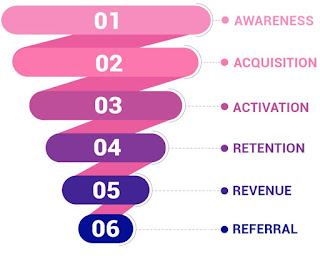
Many startups use the “pirate funnel”: Awareness, Acquisition, Activation, Retention, Revenue, and Referral (which together form the acronym “AARRR,” which indeed sounds like a pirate’s cry). I’ll explain step by step the meaning of these words to make the most of the pirate funnel!
Awareness - This phase basically coincides with the moment when a visitor discovers your brand and comes into contact with it for the first time.
Acquisition - The Acquisition phase represents the moment when people come into contact with your product and leave their details (name, phone, and email address).
Activation - This phase corresponds to the moment when the user tries your product for the first time. It’s not as obvious as it seems, and most of the time the service won’t always be used regularly.
Retention - In this phase, users return or use your product with good continuity. That’s why it’s very important to create a genuine, lasting, and solid relationship with your user. The most important data to examine are: return visitor rate, number of app sessions, bounce rate, daily and monthly active users.
Revenue - All previous efforts are needed to reach this beautiful phase: the moment of monetization and when the transition from user to customer is consolidated.
Referral - This is perhaps the most important phase of all for achieving the highest growth rate. It’s the moment when you’ll need to make your business known to your customers’ contacts. Most of the time users don’t do this without a reason (perhaps the most loyal ones do) and they need an incentive for it. Basically you have to get your active users or clients to promote the product or service to other people connected to them. How? Through a referral program that allows users, after recommending the product to their friends, to receive a reward.
Examples of Growth Hacking that have had incredible success
YouTube - Thanks to “embed codes,” people can share YouTube videos on their websites as easily as possible, allowing users to watch the video practically anywhere. Their hosting service is free and has allowed them to accumulate millions of global users and over a billion visits every month.
DropBox - It simply used an intelligent but extremely effective system of the classic “invite a friend to receive a reward.” For every friend invited, DropBox gave away 250 MB of extra memory, a strategy that allowed the company to quickly go from hundreds of thousands of users to over 4 million in less than a year.
Airbnb - Airbnb used Craigslist at its beginnings. Don’t know Craigslist but know Airbnb? That means their strategy worked very well! Craigslist was (at the time) a popular site for people looking to rent rooms or houses. At that time, Airbnb listed its offers on Craigslist with a link to their site. As a result, they were able to attract potential customers from the most popular site to their platform. Initially they promoted their listings manually, but then created a bot to automatically list the offers that attracted Craigslist users to the Airbnb app.
PayPal - This is undoubtedly the most striking case. PayPal began its rapid growth through a referral system: users were paid just for signing up. When a user referred their friends to PayPal, both received $10. As a result, they managed to achieve 10% daily growth and a total of over 100 million customers. This strategy is still used today by many companies that want to launch their credit cards (HYPE, Flowe, Circle, and many others).
Conclusion
In this article I wanted to present an interesting model that every company should know when seeking growth.
Best regards and see you soon, Victor Blanco your digital strategist
Want to apply growth hacking strategies to your startup? Contact me.